
FOR TEAMS SELLING AI AGENTS INTO REGULATED INDUSTRIES
Your agents are doing real work.Govern every action before it runs.
Argum is the control plane for the agents you run: one screen for the fleet, rules that decide each action, and a record of every verdict. Any window of that record becomes a receipt your customer can check without seeing your data.

THE QUESTIONS YOU CANNOT ANSWER
You have no controls on your own fleet.
Say your agent pays insurance claims. It runs on real policyholders, and the only thing restraining it is written instructions. Two questions you should be able to answer in a second:
"Which of my agents are enforcing a rule right now, and which are only logging?"
"What would this rule change have done to last week's traffic?"
Read the prompt
An instruction is not an enforcement point. Nothing checked that it held.
Grep the logs
Logs record what already happened. They stop nothing.
Your customer's security review asks the same two questions. That is where vendor revenue dies.
THE PRODUCT
See the fleet. Decide every action. Change the rules safely.
SEE
Every agent on one screen, its coverage read from the evidence flowing for it rather than from what the agent claims. Governed, logging only, or nothing arriving at all.
DECIDE
Rules run in code before the action does: allow it, deny it, strip a field, or hold it for a human. Every verdict is recorded with the rule version that produced it.
CHANGE
A rule change is a version someone reviews and approves before it publishes. Running agents pick it up on their next action, with no redeploy.
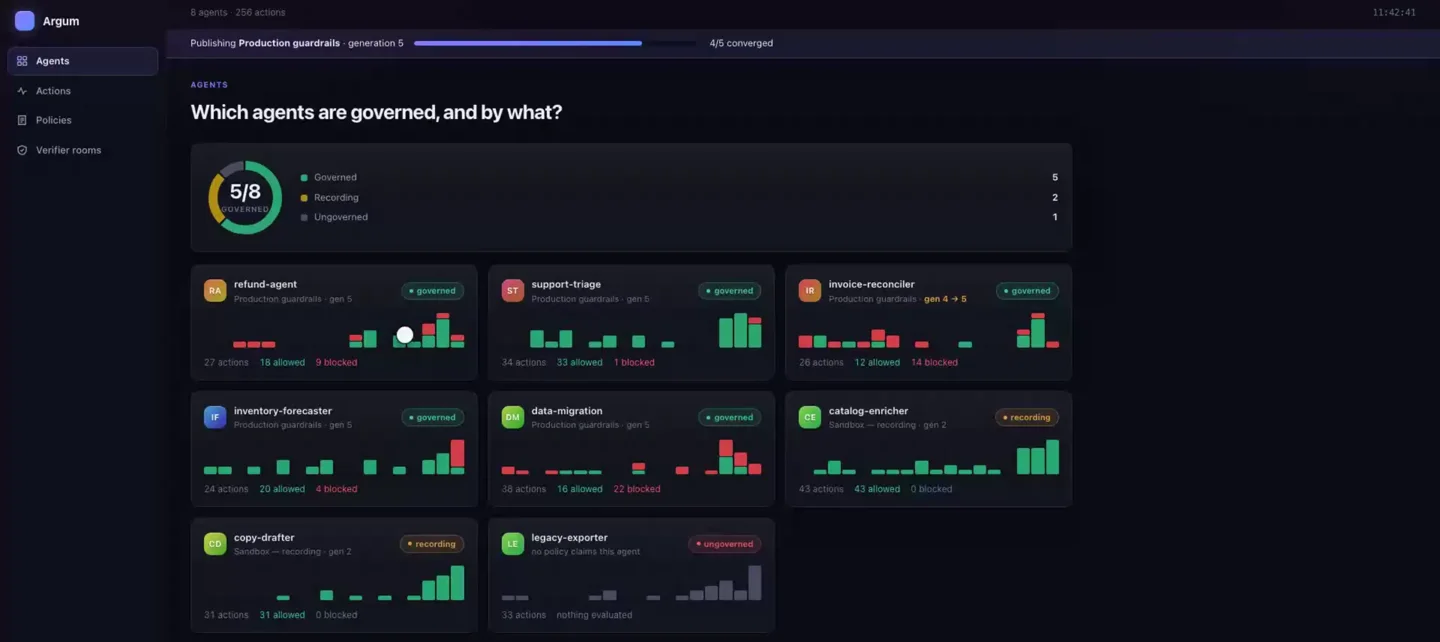
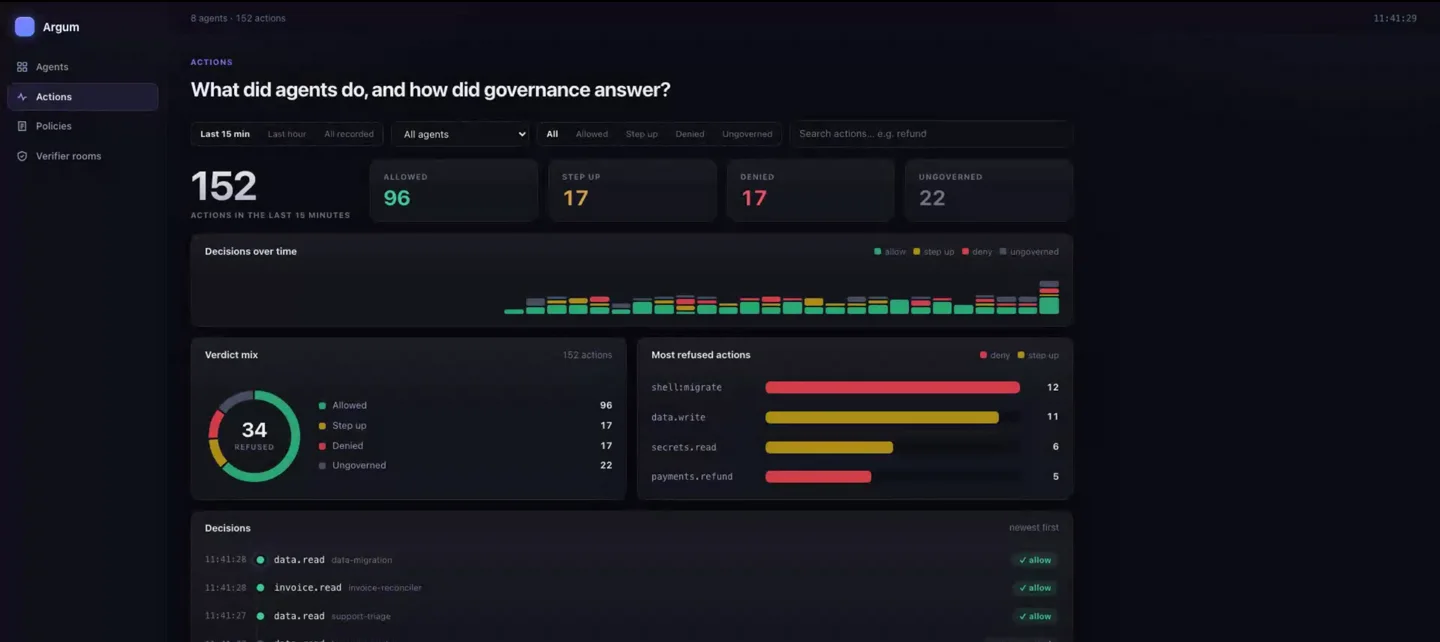
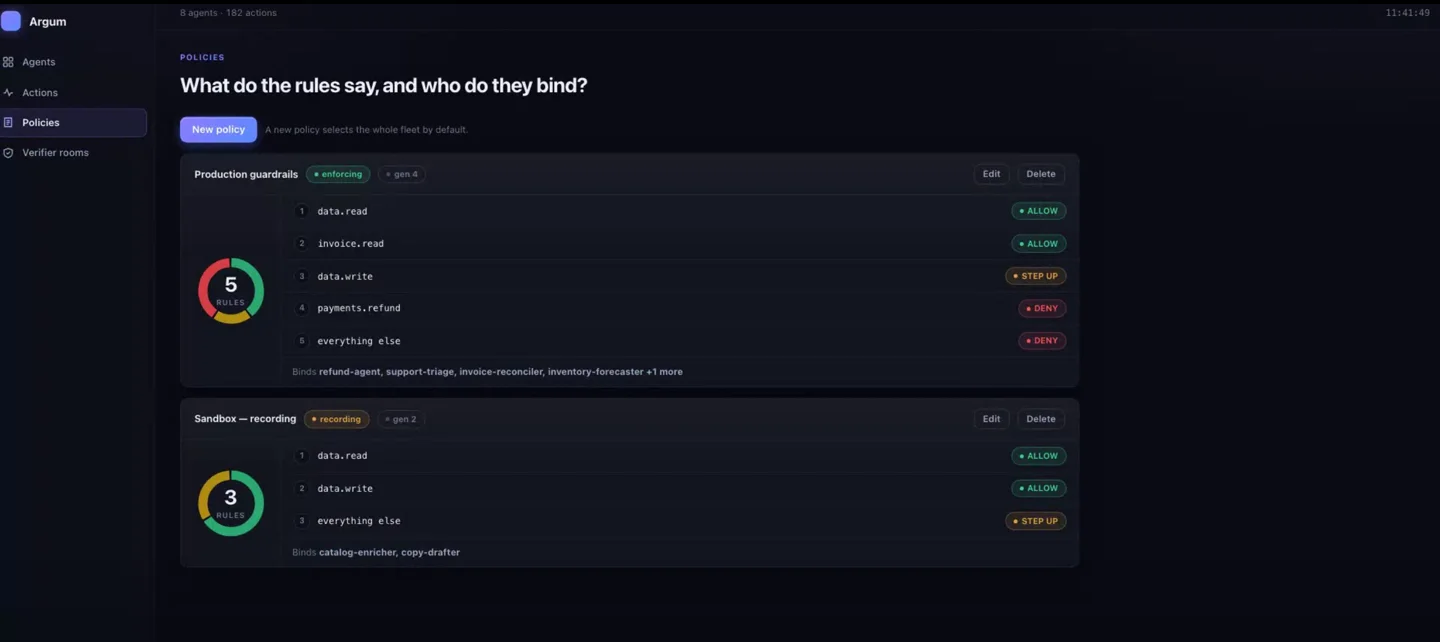
An agent can be bound to a policy and still only be logging it. The fleet view shows that as its own state, never as governed.
POLICY CONTROL
A rule change is a review, not a redeploy.
Rules live as versions in Argum, not in a prompt and not in your application code. A version is written, reviewed, and approved before it can publish, and on a dedicated deployment the approver has to be someone other than the author.
Before it publishes, replay it against decisions you already recorded and see exactly what changes: what becomes allowed, what becomes denied, which rules never fire, and which fire wider than you meant.
WHAT A CHANGE PASSES THROUGH
Every publish is recorded against the person who made it.

THE VERIFIER ROOM
What your customer opens.
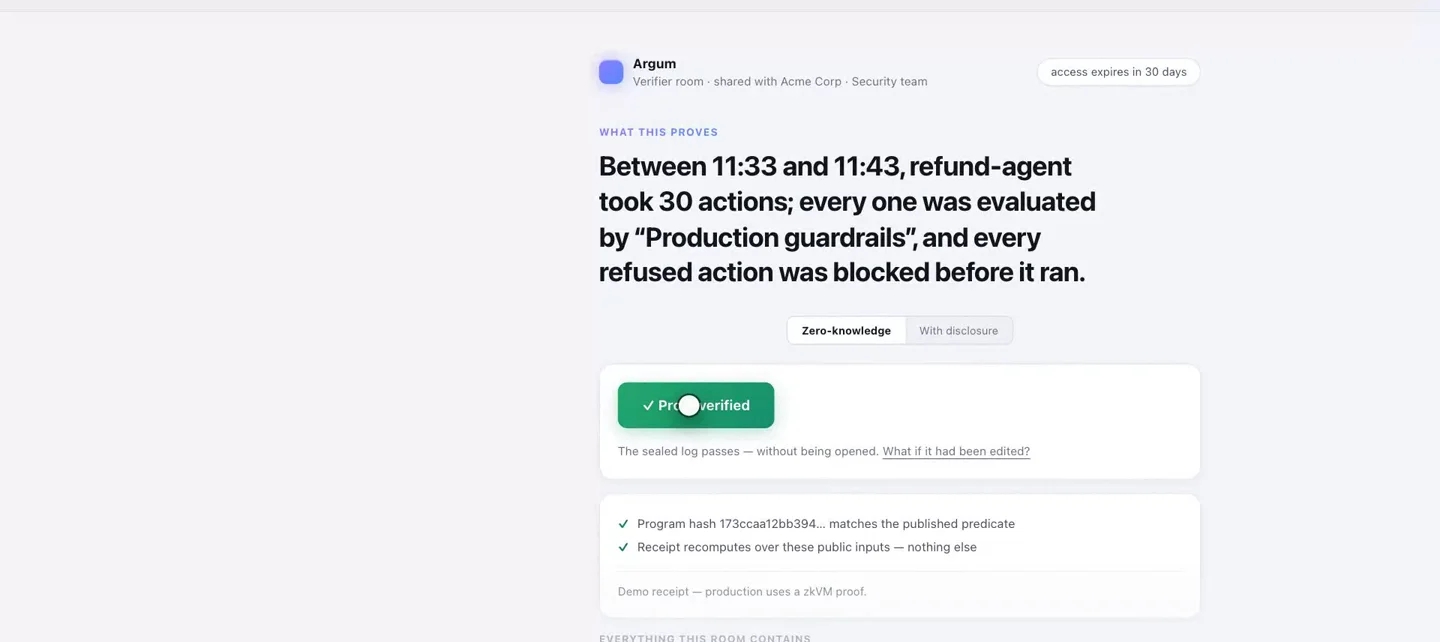
You pick a window and an agent, and you get a link. Your customer opens it and reads one sentence in plain English about what that agent did, and under which rules.
One button checks that claim against the sealed record. No account, no access to your systems, nothing leaves their laptop.
Every above-limit payout had human sign-off. No denied action (payout or record read) completed.
WHAT THE ROOM CONTAINS
Change one entry after the fact and no valid proof can be produced.
A room covers recorded evidence for the window it names, and says so on its face. It supplements audit sampling rather than replacing it.
DEPLOYMENT
It runs where your data already lives.
The default deployment is your own cloud, because regulated buyers reject a vendor ingesting their agent logs. Evidence never crosses your boundary. A hosted instance exists for teams without that constraint.
Prompts, tool arguments, and customer records default to hashed or withheld. You choose the handling per field: send it, hash it, encrypt it, or keep it local so only a hash ever leaves.
Integration today is a small enforcement hook in the action path of agents you run, plus an API. It sits beside your framework instead of replacing it.
We hold no compliance certifications yet. SOC 2 comes after the first production deployments.
An annual subscription per deployment, paid by the vendor. Verification is free for the party checking.
WHERE THIS GOES
Every consequential action an AI agent takes should be decided before it happens, and provable after.
Agents will negotiate, pay, prescribe, and file on our behalf. "Prove it" should be a link, not a lawsuit.
Building now: fleet coverage, the decision record, policy review and rollout, the first complete proof. Screens above are concept designs.
Know a team selling AI agents into regulated industries? That intro helps most.
aryansingh1009@gmail.com